Posted by Linda Dancy on October 8, 2026, 12:11 pm
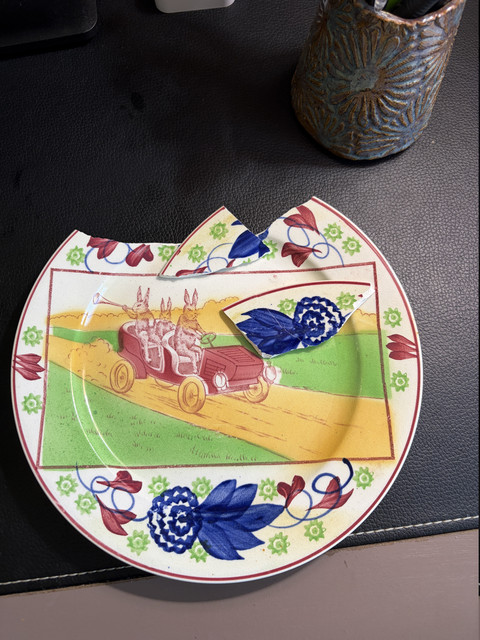
I broke a Rabbitware plate, the cute one with the bunnies in a roadster. I just couldn't throw it away. I am looking for someone with experience in gluing it black together with silver in the cracks. Does anyone know of such a person?
Re: Plate Repair
Posted by David Hoexter / TCC Web Admin. on October 8, 2026, 6:55 pm, in reply to "Plate Repair"
Hi Linda.
I am commenting from my personal point of view, not that of my "official" TCC role as web administrator. The TCC is not in a position to recommend ceramic restorers, but please read on. I'm going to accept any individuals reading your post to make recommendations, or offer their services, but be clear that the TCC is not the party making recommendations, and we cannot vouch for the quality of work being offered.
Second, I commend you on wanting to save your quite uncommon rabbitware plate. There are not many of them around. Your plate is one of six patterns in the anthropomorphic rabbit plate "Sports" series. Each of the six patterns was registered January 30, 1905 in England by the firm Baker & Co. located in Fenton, Stoke on Trent, Staffordshire.
I'm guessing that you want to emulate the Japanese method of ceramic repair, placing metal over cracks or glued repairs. I understand that there are certain philosophical aspects to this. However, let me suggest an alternative: it looks like your plate is in one large and two smaller pieces, and there does not look to be too much loss of material. Although it won't look new again, you should be able to return your plate to one piece. The procedure is simple.
It may be best to have someone working with you. Set the two fragments in place with the larger piece, pattern side down on a table. Secure tightly with small bits of masking tape. You could tape the entire fracture length from the back, and stop at that point. If you wish to continue, turn the plate onto its back (reverse) and place more tape on the front. Turn again onto the front. Working on the reverse side, use a liquid glue, available at many hardware stores; place a bead of glue along the cracks; using medical gloves to protect your skin, force the glue into the cracks with your index finger. Allow to cure 24 hours or so. You can then remove the masking tape. If you want, you can then use the same glue application process on the front for added strength, although you will have some glue smeared along the surface adjacent to the cracks. This can be removed with a cotton swab dipped in acetone (also available at hardware stores). But, use CAUTION, avoid spilling, avoid splashing into your eyes, and follow all cautions printed on the acetone container. Also, avoid the acetone coming into contact with any applied color which is not under the glaze. If any of this concerns you, stay with the reverse side only.
If any of the above makes you uncomfortable, then by all means, locate a professional restorer. I would imagine looking through the various antique publications would turn up someone.
 Back to: Transferware Collectors Club Website
