
[ Post a Response | The SteelNavy.Com Message Board ]
Posted by L'Arsenal on November 1, 2025, 7:46:26
This week we present another marvel from the duo Stéphane Trouillard (designer) and Christian Dagorn (documentation and history).
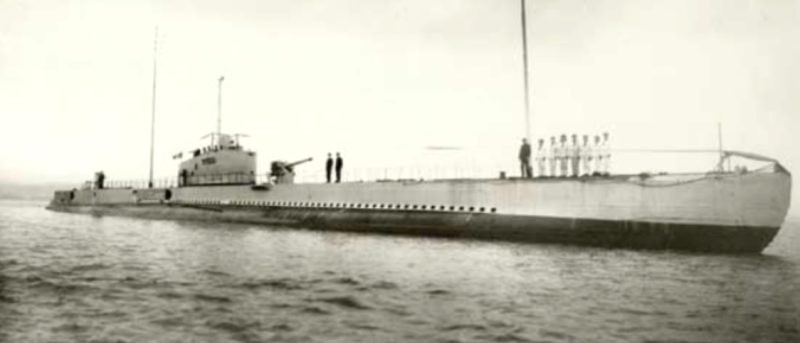
The Phoenix 1500T submarine.
Here is its incredible story:
The Phénix is a first-class, large patrol submarine of the 1500-tonne double-hull type - M6 - built in 1927.
Construction began in June 1928, it was laid down in November 1928 and launched in April 1930, entering service in October 1932.
Several attempts to deploy submarines in Indochina had been considered without success since 1905. But on 4 November 1938, the ‘Phénix’ and the ‘Espoir’ set sail from Toulon for Southeast Asia. They anchored at Port Said on 10 November 1938.
From 20 to 23 November 1938, they stopped at Djibouti, Aden and then Colombo from 2 to 8 December 1938. On 15 December 1938, they arrived in the evening off Cap Saint-Jacques (Cochinchina) where they dropped anchor. The next day, they sailed up the Saigon River, where they docked at the submarine piers at 10:00 a.m.
- The ‘Phénix’ entered the arsenal for repairs. It had suffered damage to its rudder and rear diving planes on 13 December 1938, off the coast of Singapore.
- On 10 February 1939, it was once again available for service.
- From the 13th onwards, the ‘Phénix’ and the ‘Espoir’ toured the coast of Annam. They stopped at Cam Ranh from 14 to 17 February, Nha Trang from 17 to 20 February, Port Dayot from 21 to 23 February, Cam Ranh again from 21 to 23 February, then Tourane from 24 to 27 February, returning to Saigon on 1 March 1939.
- On 7 April 1939, the Italians, on Mussolini's orders, invaded Albania. The two submarines took wartime precautions.
On 14 March 1939, they set sail from Saigon to take up their alert positions in Cam Ranh, where they remained from 15 to 17 March before returning to Saigon on 18 March 1939.
On 1 April 1939, they set sail for the Gulf of Tonkin.
On 5 April 1939, they were in Haiphong, where they remained until 12 April.
From 12 to 17 April 1939, they made a sortie into Ha Long Bay with a stopover in Hon Gay. They then reconnoitred the anchorages of Surprise Island, Merveille Island and Appowan Islet. They returned to Haiphong on 17 April 1939.
- They set sail from Haiphong on 19 April and arrived in Saigon three days later, where the crews were sent to rest in Ðà Lat.
- On 13 June 1939, the ‘Phénix’ and the ‘Espoir’ set sail for Hong Kong and then Manila to pay a courtesy visit to British and American submariners based in the Far East.
- After an exercise with the colonial aviso Savorgnan de Brazza (Bougainville class), the two submarines anchored at Cam Ranh at noon the following day. Another exercise was planned for 15 June 1939 with the cruiser Lamotte-Picquet (Duguay-Trouin class).
- On 15 June 1939 at 08:57, the two submarines set sail. At 09:30, they crossed the Cam Ranh Pass. On orders from the ‘Phénix’, they took up their lookout post at 09:37.
- A Loire 130 seaplane from Squadron No. 5, based in Cat-Laï, spotted the Phénix on the horizon at 10:07 a.m. and reported it was approaching at 10:22 a.m.
- It dives at 10:26 a.m., 6.6 nautical miles in the 76 from the tip of Cam Ranh, still heading at 60. L'Espoir also dives at 10:27 a.m., heading at 120.
- An hour later, L'Espoir surfaces after firing its torpedoes. The Phoenix, however, does not surface...
- L'Espoir began search procedures before issuing an alert at 12:18 p.m. The Admiral was not notified until 3:00 p.m., at which point he immediately dispatched Lamotte-Picquet, which arrived in the area at 4:35 p.m.
- The two ships conducted their search until 5:06 p.m. and found only a slick of diesel fuel on the surface. L'Espoir returned to Cam Ranh at 6:30 p.m.
- By nightfall, the Phoenix's oxygen reserves were theoretically exhausted...
- On 19 July 1939, the commission of inquiry formed by the Indochinese naval authorities concluded that a battery explosion had instantly incapacitated the men in the submarine's central control room, preventing them from carrying out the manoeuvres that could have saved the vessel. No official statement was issued in 1939.
- Rumours circulated that sailors boasted of having bypassed the indicator lights for opening a hatch. At sea, this would have allowed them, unbeknownst to the officers, to ventilate the stations, which had become stifling due to the humid heat of Indochina.
- The exact cause of the sinking has not been determined with certainty. The hypotheses to explain this dramatic sinking are:
• That it dived with the front hatch open...
• That, due to the poor condition of the storage battery, gas accumulated after it was fully recharged, which exploded after the dive following an electric arc;
• A short circuit in the indicator light for the opening of a descent panel. This allowed seawater to ventilate the stations, unbeknownst to the officers, which had become stifling due to the humid heat of Indochina. The Underwater Weapons Service recognised that the habitability of the ‘1500’ was deplorable in tropical climates.
No possibility can be ruled out; nevertheless, the most likely hypothesis is as follows: the high, uncontrolled hydrogen content produced when the old battery was charged filled the deck with an explosive gas mixture as soon as the kiosk panel was closed. The resulting electric arc and the activation of the electrical systems caused the explosion, and the shock wave killed the crew instantly.
A team from Brest is currently conducting research to film the wreckage, pay tribute to the victims and finally try to understand what happened.
Available in the following scales:
-1/350: price €59.95 (https://www.larsenal.com/sous-marin-phenix-1500t-1-350-en-impression-3d-c2x42294338)
- 1/400: price €49.95 (https://www.larsenal.com/sous-marin-phenix-1500t-1-400-en-impression-3d-c2x42294497)
Responses